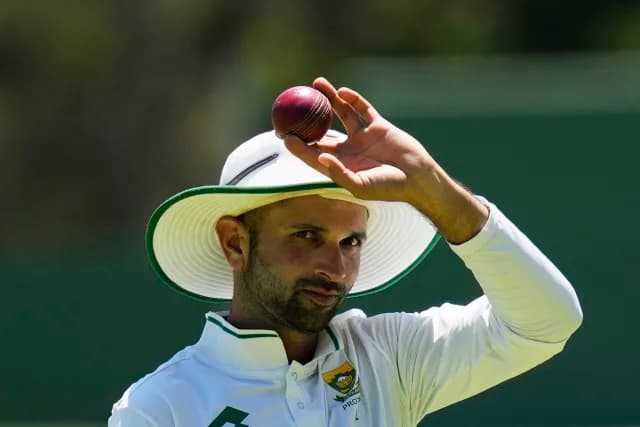
South Africa head coach Shukri Conrad has defended the decision to leave experienced left-arm spinner Keshav Maharaj out of the Test side, admitting that dropping one of the team's most dependable players was a difficult call.
Maharaj has been overlooked for South Africa's last three Test matches and is set to miss the upcoming Centurion Test against Bangladesh as well. The decision marks a significant moment in his decade-long Test career, as he has never previously been dropped from a South African Test side in this manner.
The 35-year-old spinner was disappointed with the decision but has vowed to work harder and make Conrad's selection decisions more challenging in the future. Following his omission, Maharaj was released from the national Test squad during the ongoing Test against Bangladesh and is currently representing the Dolphins in a domestic four-day match against Western Province in Durban.
His absence has allowed Simon Harmer to establish himself in the playing XI. Harmer has impressed with successive six-wicket hauls and has emerged as a key figure in South Africa's bowling attack.
Speaking to the media on Friday, Conrad acknowledged that Maharaj was understandably unhappy with the decision but praised his professionalism and commitment to the team.
"Anybody would be disappointed, especially someone who's been a stalwart in the side for many a year. But Kesh being the ultimate pro that he is and ultimate team man, whilst the initial conversations were robust and I'd expect nothing else, he is fully understanding," Conrad said.
The South African coach added that he encouraged Maharaj to return to domestic cricket and prove his worth by taking wickets.
Maharaj has already responded strongly, claiming five wickets for 62 runs against Western Province. His performance included the dismissals of recently dropped Test players David Bedingham and Kyle Verreynne, underlining his determination to fight for a place in the national team again.
Conrad admitted that leaving out an experienced player is among the toughest responsibilities of a head coach.
"There's no soft way of putting it. You basically sit a guy down and you say, 'you're left out and these are my reasons,' and yes, they'll get upset. It's often the toughest part of the job. But the truth only hurts once," he explained.
Despite his absence from the Test setup, Maharaj remains an important part of South Africa's plans in limited-overs cricket. He has been named stand-in captain of the ODI squad for the upcoming Bangladesh series, replacing the injured Temba Bavuma.
Maharaj has previously captained South Africa in one Test, seven ODIs and 10 T20 Internationals. He is also expected to play a significant role in the country's preparations for the 2027 ODI World Cup, which South Africa will host.
Conrad highlighted Maharaj's importance in the 50-over format, particularly because quality spin bowling can play a decisive role in South African conditions.
Meanwhile, Bavuma's fitness remains a concern for the team management. The South African captain is dealing with a calf injury that will keep him out of the Centurion Test and the white-ball matches against Bangladesh.
Conrad expressed optimism that Bavuma would recover in time for the upcoming three-Test series against England, scheduled to begin on December 17.
"We're going to try our damndest to make sure that he's ready for the England series. I'm fairly optimistic that he'll be available, if not for the entire series then for a huge chunk of that England series," Conrad said.
He also stressed that Test cricket remains South Africa's immediate priority, with the team currently well-positioned in the 2025-2027 World Test Championship standings and aiming to qualify for a second consecutive final.
Looking ahead, the coaching staff will also focus on managing players' workloads and ensuring that key members of the squad remain fit for the 2027 ODI World Cup.
For now, Maharaj appears to be outside South Africa's immediate Test plans, but his experience, leadership qualities and performances in domestic cricket could help him earn another opportunity.
Conrad summed up the challenge of making difficult selection decisions by emphasising the importance of separating emotions from professional responsibilities while maintaining respect for players.
"A lot of the time you've got to take the emotion out of it. But there is a human element," Conrad concluded, highlighting the delicate balance between team selection and managing the expectations of experienced international players.